Photos

Bergama Theatre Bergama Trajan Temple Dalyan Lycian Tombs Kaprulu Kanyon Afrodisias Tetrapylon Demre Beach Ortahisar Volcanic Plug Goreme Sunset View Yoruk Turquoise Treasures and Volcanic Vistas draw Travellers to Turkey
All photos copyright © 2014 Terra Encounters All Rights Reserved

Friday, 15 May 2015

Blue Mosque Interior

Is the Dome Blue?

Is The Blue Mosque Blue?

Blue Mosque Interior | Istanbul Turkey | Terra Encounters in-depth
The mosque is one of the defining features of Istanbuls skyline and a World Heritage Site.  Sultan Ahmet Cami (pronounced ja-mee) is better known as the Blue Mosque but is it really blue?
 
Not a Blue Breath


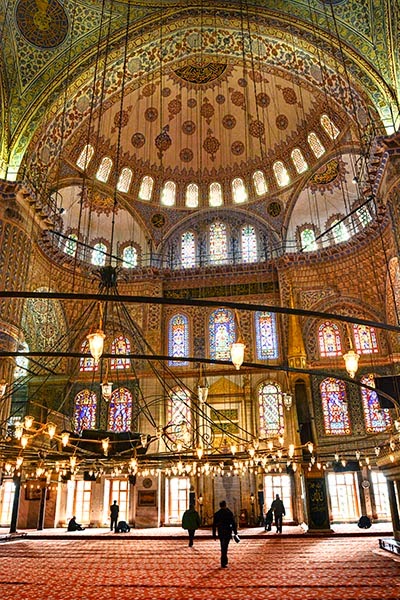
Entering the huge hall, your breath is taken away.  However, it is not a blue breath.  Blue is not even a dominant colour.  Except for the blue background of the calligraphy, don't expect to see blues as rich as the spectacular emeralds of the Green Tombs in Bursa 

Luscious Light
Instead, there are many colours but they are muted.  The light pastels and white spaces enhance the perception of peacefulness. You don't even register that this is a huge dome.

Sunlight pours through the large number of windows in the dome adding to the feeling of weightlessness.  Glass was one of the inventions of the Middle East and Europe that travelled east along the Silk Routes to the Far East.
 
Venetian Glass?
The coloured glass originally was a gift to the sultan from the Signoria, the government of the Republic of Venice.  Venice went from Byzantine province to naval powerhouse, from trade funnel between Asia and Europe, to the third largest city and patron of art in Medieval Europe.  But don't expect to see exquisite Venetian glass, which has mostly been replaced by panes of lower artistic quality. 

The architect, Mehmed Ağa, like his mentor 
   
Pendentives
Sinan, married Byzantine to Islamic architecture.  The windows were clearly copied from the Byzantine Church of Hagia Sophia Dome-ination.  The dome transforms into spherical pendentives copied from Süleymaniye Mosque, Sinan's masterpiece.
    
Massive Columns


The central dome rests on four massive fluted columns often called elephant feet.  This allows for a huge central space without the use of arcades of columns as in the Ancient Roman or Medieval basilica.  Cascades of domes seem to spill down from the great central dome.


Islamic Doors

Masters of Symmetry
After removing your shoes, tourists must enter the south door.  Pause and enjoy the typical Islamic patterns carved into the rich dark wood.  The predominant Sunni sect is still adamantly opposed to images of sentient beings.
   
Images of any kind – animal, human or God – are not allowed in mosques. The reason for this is that Islam strived to end pagan worship that existed in Saudi Arabia. 
   
As a result, Islamic artists became masters of geometric patterns and calligraphy.  Symmetry and harmony is at the heart of Islamic art.  The patterns are not random.

İznik Tiles

   
Blue Tiles = Blue Mosque


Finally, we solve the question of why this is called the Blue Mosque.  The interior is lined with more than 20,000 handmade İznik ceramic tiles that are famous for the colour blue. However, they are still not a saturated blue.  The tiles have brilliant green and turquoise hues as well as blue and white. 

 
Now That's the Blues

The tiles are mostly in the inaccessible upper galleries.  Tourists are restricted to a small and separate area in the back of the ground floor.  You cannot walk around the hall nor climb to the upper galleries.  This means you need binoculars or a zoom lens to see the tiles.  The tiles display more than fifty shades of tulips, which came to Europe from Turkey. 
 
Upper Gallery Blues

The tiles at lower levels are traditional in design, while the gallery tiles are full of flowers and fruits.  For close up views of Iznik tiles, visit the Tile Kiosk in the Istanbul Archaeological Museums.
 

Islamic Prayer

Typical Floor Carpets
To the right of the mihrab is the richly decorated minbar (pulpit) where the imam stands when he is delivering the Friday sermon.  The floors are covered with carpets, which are donated by the faithful and are regularly replaced as they wear out.  Each pointed arch design in the rug marks a spot for a worshiper.
Islam requires all Muslims to pray five times a day (salat).  Find out the times in advance and be aware that they close the mosque to tourists 45 minutes before these times.  You could be waiting a long time.  In this case, look around outside as well as down the streets to see the south and west facades. 
 
Facing Mecca
However, Islam is not the only religion with this practice nor did it invent it.  Mohammed borrowed Jewish and Zoroastrian traditions.  The Judaic custom of praying three times a day (facing in the direction of Jerusalem) was originally introduced by the patriarchs Abraham, Isaac and Jacob.  These patriarchs of the Torah (Old Testament) are also patriarchs in Islam.

Private Prayers
Zoroaster lived in Ancient Persia but the dates are unknown.  It has to precede the period when Zoroastrianism became the dominant religion between 6th century BC and 6th century CE.  His real name was Zarathustra but he was called Zoroaster by the Greeks.  Elements of his philosophy travelled to the West through Judaism and Greek philosophy (Heraclitus).  There are still believers today. 
Zoroaster grew up with the Indo-Iranian pantheon, the same pantheon described under the PIE (Aryan) religion in the Dalyan and the Lycian Tombs post that was the basis for the Ancient Greek, Roman and Hindu gods.  Zoroaster dramatically simplified this pantheon into a dualistic monotheism with two forces (essentially good and evil) under one God.

Influences
Mithraism (another PIE-based religion) and its’ descendant, Zoroastrianism, were the major competitors as well as influencers of early Christianity.  See the Patara and Saturnalia post for examples of the incorporation of local customs to get people to adopt a new religion. 
    
Paisley Tie
The impact of Zoroastrianism can even be felt by modern Western civilization.  The paisley ties and textiles are not from Scotland or Kashmir; they are from the boteh motif of Ancient Persia.  It was part of the Persian inheritance from the Aryans.  In fact, Iran means land of the Aryans.
The twisted raindrop (boteh) is the quintessential metaphor of the confluence of Islamic art and Zoroastrian symbolism.  It originally represented the upright cedar tree that Zarathustra planted in paradise bent by the Muslim conquest of Persia and decorated with Islamic floral motifs.  Boteh originated in the Sassanid Dynasty (224 - 651), the last dynasty of the Persian Empire before Islamic rule.  In fact, much of what became Islamic culture was transferred from Persian art, architecture and customs. 
Sultan Ahmet Cami

Zoroastrianism, the national religion of Sassanid Persia, thus had a major influence on Islam.  One Zoroastrian tradition was to pray five times a day. Another major Zoroastrian concept is that man had free will to choose his own path between good and evil, heaven and hell.  This is the basis of all Abrahamic religions – Judaism, Christianity and Islam.  
 
Last Post:  Blue Mosque Exterior
Next Post: Kool Kadıköy


Saturday, 9 May 2015

Blue Mosque Exterior

Sultan Ahmed Mosque

Is The Blue Mosque Blue?


The mosque is one of the defining features of Istanbuls skyline and a World Heritage Site.  It is better known as the Blue Mosque but is it really blue?  The exterior looks more grey than blue.  The interior does not look blue at all. This is not the Green Mosque in Bursa!  Perhaps we tourists should just call it by its proper name, Sultan Ahmed Mosque or Sultan Ahmet Cami in Turkish.

It was built at the beginning of a long period of gradual decline of the Ottoman Empire.  At the start of the teenage Sultan's reign, both Austria and Persia had scored victories over the Ottomans.  The Persians in 1603 reclaimed Tabriz (Persia) and the Caucasus states of Georgia and Azerbaijan.  A 1606 treaty ended Austria's annual tribute-paying status and recognized them as a sovereign state (Hapsburg Dynasty).  There was no war booty in 1609 to finance such an extravagant building.  So why was such a grandiose mosque built?  One possible explanation was that the mosque was built to deflect criticism; in other words, it was a propaganda campaign and statement of power.  

Sultan Ahmed Mosque
Sultan Ahmed I came to throne at the age of 13: his mother was Greek BTW.  He broke with the 200-year-old Ottoman tradition of fratricide yes, all brothers were usually killed to prevent them from claiming the throne.  The tourist district where many of us live and visit is named for this sultan.  However, he wanted to leave something permanent behind so he would be remembered. He wanted to build a mosque that would be more magnificent than any previous one. 

Ahmed was directly involved in the design of the mosque.  Even in those days, it paid to get along with the boss.  Unfortunately for the first architect, he was executed by Ahmed.  The mosque was completed in 1616, just one year before Ahmed himself died of typhus at a mere 27 years old! 

The mosque was designed by architect number 2, Mehmed Ağa, a student of Sinan, the great Ottoman architect of Süleymaniye Mosque Dome-ination fame.  Mehmed Ağa also died in 1617, a year after the mosque was completed.
   

Hagia Sophia ... so close
Mehmed Ağa didn't strive for overwhelming size, majesty and splendour.  He designed the mosque to meet the expectations of his sultan to make a monument greater than the church (even though it was now a mosque) of Hagia Sophia, which interestingly is just on the other side of the Hippodrome.
  

Cascading Domes

The mosque was deliberately built on the site of the palace of the Byzantine emperors. This was controversial since it meant destroying the existing palaces of the Sultan's ministers.

For the spectacular sunlit view of the east or Hippodrome side come in the morning.  The Sultan Ahmed Mosque surely wins over Hagia Sophia for its exterior with cascading waterfall of domes contrasted by six pointed minarets.   


Blue Mosque Minarets

  
Ahmed's Minarets
Each of these pencil minarets has three balconies, like rings around each finger.  Imagine the old days when the muezzin had to climb a narrow spiral staircase five times a day to announce the call to prayer.
   
Most mosques have one or two minarets.  Mosques built by sultans usually have four minarets.  But Sultan Ahmed Mosque has six minarets.
     
Some travel tales say that when the number of minarets was revealed, the Sultan was criticized for trying to match the number of minarets in Mecca and that Ahmed ordered a seventh minaret to be built in Mecca. 
 
But evidence to support this claim is pencil thin since at that time there were only four minarets at the magnificent mosque of the Kaaba in Mecca.  It was long after Sultan Ahmed died that the holiest mosque of Islam was rebuilt.  In 1629, three more minarets were added so that the Kaaba was surrounded by 7 minarets.
  
Ahmed's Garden
If like us, you find that the interior is closed for one of the daily prayers, you could be waiting a long time.  In this case, look around the outside as well as down the streets to see the south and west facades.
 
The court is about as large as the mosque itself and has manicured gardens with - what else - tulips.
 
Ahmed's Arcades


The mosque is surrounded by a continuous vaulted arcade.  Below the arcade are water taps.  When the believers hear the call to prayer from the minarets, they perform their ablutions (washing) and then pray.
  
Also, you can walk down the streets to see the south and west sides of the mosque.
 

Doorway to High School
  

Because the east side was backlit, the alternative was to search out a view of the façade in the sunlight on the west side. 
     
Doorway to Heaven


 There were interesting things to see on the way.  There was a gateway into the Sultan Ahmed Mosque and a high school at a recess break. 

East Turkestan Restaurant


Along the "painted street" we saw Turkish writing on the buildings and wondered what it meant?  Kurtulus sirasi (text in the photo) means "during the liberation".  Where is East Turkestan that needs freedom?  We didn't think it was Eastern Turkey.  East Turkestan means the homeland of the Islamic Uighur people of Xinjiang province of China.  This is supposedly a restaurant owned by an East Turkestani expat.
 
Painted Street


So is the Blue Mosque really blue?  You have to check out the next post to find the answer. 


Next Post: Is The Blue Mosque Blue?

Saturday, 2 May 2015

Hippodrome Istanbul

Hippodrome

Hippodrome – Off to the Races

Hippodrome | Istanbul, Turkey | in-depth travel advice from Terra Encounters
The Ancient Romans and Greeks are descendants of the Proto-Indo-European (aka Aryan) tribes who were a horse riding culture from the Caucasus.  The PIE invented the chariot and it was the primary war technology that enabled the PIE tribes to invade India (Vedic people), Turkey (Hittites and Lycians) and Europe (Romans, Greeks, et al).

Off to the Races
So it is not surprising that the ancients loved chariot racing.  Built in the 4th century CE, the Hippodrome was a 100,000 seat venue for chariot races and other entertainment.  The name is derived from the Greek words hippos ("horse") and dromos ("course").  I wonder what the tickets cost?  Unfortunately, nothing is left of the stands, which were mined for building materials.  All that is left is the modern road paved over the location of the oval race course, which is actually well below the current ground level.

The park before the Blue Mosque was the location of the royal lodge, where the imperial family watched the races. It was connected to their palace, which stood on the grounds of the Blue Mosque (coming to a post near you).  
 

Tripod of Plataea

Delphi, Greece
All empires pillage the art and sculpture of their conquered territories.  The Byzantines decorated the spina (spine) of their track with artifacts from around the empire.  Constantine ordered the Tripod to be moved from the Temple of Apollo at Delphi and set in middle of the Hippodrome.
 
Serpent Uprising
The Tripod of Plataea, now known as the Serpent Column, may not look like much.  It celebrates the victory of the Greeks over the Persians at the Battle of Plataea (479 BC).  One of the Persian objectives was to punish Athens for supporting the Ionians, who occupied the Turquoise Coast.  The war ended with the defeat of the Ionians in a naval battle outside Miletus (their capital) in 494 BC.  While the Persians conquered Ionia (temporarily), the war marked the last time the Persian Empire attacked mainland Greece.

What you see today is the bodies of three serpents twisted into one pillar of brass.  What you don't see are the three heads supporting a golden tripod.  What you don't know is that the bronze column was built using the bronze from the melted-down Persian weapons.

Obelisk of Thutmose III


1/3 of Original Obelisk!
The Obelisk of Thutmose III was originally erected at the Temple of Karnak in Luxor during the reign of Tuthmosis III in about 1490 BC.  Theodosius had the obelisk cut into three pieces and brought to Constantinople.  Today only the upper third remains! 


Racing with Theodosius


One of the most interesting things is to examine the rectangular base closely.  Bas-reliefs on the base depict Emperor Theodosius watching the races from the Royal lodge. 

How to raise an obelisk

The Hagia Sophia side depicts the raising of the obelisk using pulleys.  It's still hard to believe how they could lift such heavy red granite. 
 
Another more recent monument is the German Fountain, which will be described in a future post. 
 

Nika Riots


The New Empire
Emperor Justinian (527 - 565) expanded the empire to its greatest extent reclaiming much of the original Roman Empire.  He took back Northern Africa from the Vandals and Dalmatia, Sicily, Venice and Rome from the Ostrogoths.

Chariot teams were identified by colours blue, green, red, and white. Social/political classes would support their own chariots.  The team associations had become a focus for various social and political issues for which the general Byzantine population lacked other forms of outlet. 


To Victory -- Nike!

The Nika Revolt was named for the rebels battle cry "Nika", or victory.  This derived from the Greek goddess of victory, Nike, whom we met in Ephesus -- she is also the origin of the name of the running shoe company.

The Nika Riots were a sports riot fuelled by rivalry in the Hippodrome and opposition to the high taxes impose by Emperor Justinian!  At this same moment he was negotiating a peace treaty with Persia.

Justinian had called for races on January 13th. By the end of the day the crowd changed their chants from blue or green to Nika. For the next 5 days they assaulted the palace.  They started fires.  Some senators opposed the new legal system and the new taxes saw this as an opportunity to overthrow Justinian and declare a new emperor in the Hippodrome itself.  Justinian paid off the Blues in gold and they left in the middle of the coronation in the Hippodrome.  The imperial troops then killed the remaining Greens.  In the end 30,000 rioters were killed.  So that rivals any soccer/football hooliganism of today!

Hagia Sophia v3.0
Half of the city as well as Hagia Sophia version 2.0 was burnt down during the Nika riots.  Justinian then built the current version 3.0 of Hagia Sophia with the largest dome raised since the Pantheon in Rome.


Vitale Byzantine Mosaics


He built the Byzantine mosaic masterpiece of San Vitale Church in Ravenna, Italy.  He constructed several underground water supplies like the Basilica Cistern, to ensure adequate water supply in the event of a siege.

His biggest legacy might be the rewriting of Roman law, which is the basis of civil law in many modern countries.  So why did the Byzantine Empire decline?  It started with the bubonic or Justinian plague.  We who live in the present cannot appreciate the impact of huge losses of population.


Next Post: Blue Mosque Exterior