Photos

Bergama Theatre Bergama Trajan Temple Dalyan Lycian Tombs Kaprulu Kanyon Afrodisias Tetrapylon Demre Beach Ortahisar Volcanic Plug Goreme Sunset View Yoruk Turquoise Treasures and Volcanic Vistas draw Travellers to Turkey
All photos copyright © 2014 Terra Encounters All Rights Reserved

Saturday, 30 May 2015

West Turkey Itinerary

Terra Encounters Turkey Trip – 31 days


Göreme
Overall, this was one of our best-ever vacation trips.  This is because of the friendliness and hospitality of the people and not just the sights.  Our trip summary gives the best places to go, in our opinion, for a 31-day trip.  We have also attached stars to each destination to give a sense of what is most worthwhile seeing.  Our ratings take into account the many places we have seen around the world.
  
Because this trip report is very long, we have split our itinerary into two segments so that those of you who only have a couple of weeks can use one or the other.  Do not ask which is better: all the places we visited in Turkey were good choices.  But first, we will cover some of the logistics. 

Accommodation


Every traveller goes to hotels at the standard of living s/he desires and the budget they have.  We prefer places that provide good value.  We did not go to the cheapest places like when we backpacked around the world.  We chose to stay in family-run or small hotels (sometimes called pansiyon in Turkish).  In the off-season, we could go to places that in high season would be much more costly.  Istanbul and Bursa are more expensive: we averaged TRY 192/day in low season.  In the rest of the country, we averaged TRY 128/day for a double.

Travel Pace


Once you decide on your primary destination, you should assign at least three nights and preferably four to it.  In our case, we chose four nights in Istanbul and Göreme.  Then with the remaining days, you can determine the number of additional stopovers by using our rule of thumb of a minimum of two nights for each destination since at least half a day of that is required for travel.  Even though we had 31 days, there are always choices to be made.  Turkey is the size of Britain and France combined. 

Each place listed below is described in more detail along with photos in our posts on the Terra Encounters blog.  All underlined text below are hyperlinks that will take you directly to the most relevant post.  

For shorter trips, it is recommended that you focus on one geographic area reducing the number of places as well as travel time.  On the other hand, you may be able to add some of the other places we considered on our More Places page. 

Travel Mode


For this 3700 km trip, we rented a car.  Yes, that is very expensive, especially with the TRY 4.60/liter gas.  Some Aussie travellers had a neat idea.  They travelled between major destinations by public transport.  Then they rented a car to do side trips to national parks and more remote places.

West Turkey Itinerary


For a visual overview of the first part of our trip, see Itinerary Map 1.  

Istanbul **** 4 nights

Spent 8 nights in IST altogether: Yes, there is that much to see but on a shorter trip, you can spend less time here by reducing what you do. The following is what we saw in the first stay there. 
 
Sirkeci Mansion
AIRPORT: very inefficient, very long lineups to go through security and immigration.  Allow sufficient time.


HOTEL: Hotel Ilkay upgraded to Sirkeci Mansion **** great location, fabulous staff, like having personal travel advisors, unbelievable breakfasts.  Book directly to get free airport shuttle for a long (4 day) stay.
 
Live Like a Sultan
Topkapi Palace Paradise – definitely worth a day.  There is a separate ticket the Harem.  We would highly recommend it if you have the time.  Here you will see close up the beautiful Iznik tiles and carved wood decorations where the Sultan's family lived.  It is also useful to go there when everywhere else is so busy and then go to the jewel and weapon rooms (the most congested areas) at the end of the day.  


Hagia Sophia Dome-ination –
Dome of Dreams 
the most significant dome and building of the Byzantine era that influenced Ottoman and thus Islamic architecture

Istanbul Archaeology Museums – meet Alexander the Great, Iznik tiles, and other important artefacts that talk about the impact of Turkey on the world


St. Peter

Chora Church Mosaics – magnificent Byzantine gold mosaics

Süleymaniye Mosque Dome-ination – incredible domes of this Ottoman masterpiece

Spice Market – buy delicious Kurukahveci Mehmet Efendi kahve (coffee), Turkish Delight, and hazelnuts

We did all the “museums” at one time because the weather was cold and dreary and we bought the Museum Card.  We do not recommend the card.  You are limited to five days, can only go to each museum once, and must visit all museums at one time.  Not many tourists want to spend all their time indoors.  Secondly, there is no discount if you only go to the top three places.  Any National Park card gives unlimited visits over a significant timeframe at a significant discount.
 

Bursa ** 2 nights


HOTEL: Hampton by Hilton very modern, business like, north of downtown, free parking, VG self-serve breakfast
Emerald Wonder


Green Mosque & Tomb *** – it is really Yeşil Türbe (Green Tomb)  opposite the mosque that blew us away and is the must-see with its unbelievable shades of green, so do not miss it!


Cumalikizik

Cumalikizik, Bursa – Ottoman Delight ** – the first is a small, old Ottoman village (do not expect incredible architecture like the wealthier Safranbolu but it was pleasant walk in the off-season when there were very few tourists) and the second is the old walled district of Bursa with nice views from the ramparts near the Türbe.

 
Acrophobics Avoid!
Bergama ** 1 night

HOTEL: Red Basilica very nice manager, E breakfast, good location

Pergamum Acropolis ** – loved the spectacular setting and the precipitous theatre

Selçuk *** 3 nights


HOTEL: Homeros Pension – great place, location, decor, and breakfast; can easily meet other travellers in dining/living room; we even ate supper here just for that reason

Famous building was a library
Ephesus *** – the top archaeological site of Turkey but overrun with tourists; spent all day here; actually is busiest from the opening until lunch then much less people the rest of the day

Şirince * – old Greek town famous for white-washed houses, wine, et al.; spent afternoon of our arrival day here
 
Ionic Columns are from Ionia
Priene – Connection to Architecture? *,
Miletus – What is a Vomitorium? *,
Didyma and the God Apollo – these ancient ruins are all close together but require a car or a tour; we spent all day and did not have enough time to visit Lake Bafu.
 

What's a Tetrapylon?

Afrodisias – Archaeology Aphrodisiac ***


If you have a car, you can visit nearby Afrodisias, on the way to Pamukkale.  However, it is very difficult to get to by dolmuş.  Rent a car or take a tour.  It is one of the nicest archaeological sites in Turkey with some actual buildings still standing or reconstructed!  Its’ fairly compact size gives a very good idea what an Ancient Roman city looked like.  Needs a half day.

Pamukkale – 2 nights


First day was Afrodisias and travel time; so we really had only one day here. 

HOTEL: Melrose House Hotel very warm owners, good conversations, E breakfasts and suppers
 
Where has all the water gone?
Pamukkale Terraces – notice no stars.  Only a few places in Turkey were disappointing.  The Pamukkale Terraces were very disheartening with hardly any water in the "thermal pools".  They are not worth the price of admission. 
Most of the water goes into pools that visitors can walk into.  I am sure this appeals to many tourists but it is not what a thermal area should look like.  If you want to see thermal areas go to Whakarewarewa (Rotorua), Orakei Korako (New Zealand) or Yellowstone National Park (USA). 
Theatre Stage


Hierapolis Ruins ** especially the theatre ***

However, Pamukkale admission also includes the Hierapolis Ruins, which were a pleasant surprise.  The theatre made the price of admission.

Dalyan ** 1 night

Lycian Tombs

Dalyan was one place that deserved more time – not for the laid-back town but for the places nearby.  This is a case where one day really is only a half day at your destination.  If it were beach weather, wouldn't you want to spend time swimming at one of the best beaches in Turkey? 

Iztuzu Beach ** –  Trip Advisor ranks it as one of the top 25 beaches in the world!

Kaunos Lycian Tombs *** –  spectacular, high up on a tall cliff.  But who are the Lycians?  Click the link to find the surprising answer. 
 

Kaş *** 2 nights


HOTEL: Hideaway Hotel was one of the best in TR; E breakfast with a terrace view, E coffee

On the way there: Ölüdeniz – overrated, narrow beach with the sea that is not as turquoise as in the over saturated photos in the tourist brochures

Soft Sand Patara
Patara *** – best beach we saw in Turkey, a world class beach with historically significant ruins – the site of the world's first parliament, whose constitution has influenced most democracies

Kaputaş Beach * – cute beach in a cliff-enclosed cove fringed with turquoise water; near to Kaş so probably dolmuş to get there

Off-season Kaş 
Old Kaş – small but enjoyable with overhanging balconies and plants

Kaş Market – every Friday, be sure to eat here the gözleme

View high up from park on road going down from main highway; Çukurbağ Peninsula; Old Roman Theatre

Kekova Kaarst
Day Trips: Kekova Sound *** spectacular karst scenery but need car so you can stop for views, else book a boat trip over sunken ruins

Could easily spend more time in Kaş, a great "vacation from the vacation" spot

Kiyi Hospitality

Çıralı 1 night


HOTEL: Kiyi Pension E owners, fantastic so meals, so welcoming

Çıralı itself could be skipped but we had a great stay on a farm B&B.  Beach is pebbly and overrated.

 
Turquoise Treasure

On the way to Çıralı:
 
Demre - Turquoise Coast Treasures for perhaps the most beautiful turquoise sea views **
 
 
Next Post: Spicy Istanbul
Last Post:  Kool Kadıköy

Saturday, 23 May 2015

Kadiköy

Kool Kadıköy

 
Bye Bye Beyoğlu
Kadıköy is the "real" Istanbul that resides across the busy Bosphorus in Asia.  Sultanahmet is mainly for tourists and workers in the tourist industry.  Kadıköy is where the locals work and play.  The shops and markets are for the locals.  Live music is a passion captured in a video below.  
Crowd watching us leave
 

Unlike Southern Turkey, Istanbul was mainly dreary if not rainy in March.  But today it was gloriously sunny and we had finished our planned day a bit early at 15:00 h.  So we decided to take our first ferry trip across the Bosphorus to Asia.  That was mistake number one.  We would have loved to spend more time in Kadıköy.  Many Turks came to see us off! 

Galata Tower

 
Mistake #2 was that the afternoon is not a good time to get views of the skyline of historic Istanbul.  Aya Sofia and the Blue Mosque were backlit as the ferry sped away from the historic district.  Moreover, the ferry does not travel along the shore of the Sultanahmet peninsula. 
 
We did have great views of Beyoğlu.  The most impressive landmark is the Galata Tower.  Even today, this is still one of the most photogenic views of the otherwise overly modern and blah cityscape.  
 
Galata Tower
At nine stories, Galata Tower was the highest building in Ottoman times. But wait, that tower looks Italian?  The Romanesque tower was built in 1348 by Genoa, who were rewarded for their support of the Byzantine Empire vs. arch-rival Venice.  Genoa controlled this area until the Ottomans took over Constantinople in 1453.  Beyoğlu, which was outside of Istanbul in those days, was where embassies and foreigners lived – even today.
 

Kadıköy

Today was not for seeing sites even though Kadıköy is the location of the Ancient Greek city of Chalcedon.  It also became part of the Ottoman Empire 100 years before the Fall of Constantinople in 1453.  We never realized that 1453 marked the fall of the city of Constantinople; Anatolia had long been part of the Ottoman Empire.
Our Welcoming Ceremony


Once we got off the ferry (vapuru), we walked through the busy quay to the right.  There were young kids performing to make some money.  It was a different atmosphere.  It was not clear where we were going but we went with the other people across the busy intersection to Söğütlü Çeşme Cd (çeşme means fountain) then turned right onto a small lane and then left.


Yasa Caddesi

 
Boy Band

We probably walked southeast on Yasa Caddesi (Law Street).  This brought us to a junction where there was a large group of people listening to live music.  An all-male band were singing songs to the crowd.

Live from Kadıköy!


Güneşli Bahçe Sokak 

 
Street Music
In theory, we were heading for Ciya Sofrasi Restaurant. Make sure you bypass the Ciya Sofrasi Express (kebab) place on the right and go to the more popular and earlier place on the left.

In reality, we were immersed in the everyday life of a big city.  We went SE one more block to Güneşli Bahçe Sokak.   
 
Street Market
The sokak (street) was little more than a pedestrian only lane.  Güneşli Bahçe is an appropriate name since it means sunny garden. 

Suddenly we were in a dense street food market.  This is the place to get things. The colourful market had mounds of colourful spices, fresh fish and vibrant fruits and vegetables. 
 
Fish neatly laid out

So what's for supper?  At the fishmonger, you can buy levrek (perch) for 18 TL/kg, uskumru (mackerel) for 8 TL/kg, or Karadeniz somon (Black Sea salmon) for 14 TL/kg. 


Street Snacks
 
 
At the fruit stalls, you can purchase yeşil armut (green pears), dut (mulberry), and portakal (oranges) for 3.50 TL/kg.


Olive-ganza
Green Pears


Are these vine leaves for hakiki (real)? 
At other stalls, you can purchase cizik zeytin (green olives) for 19.80 TL/kg, biberli zeytin (olives stuffed with peppers) 16.80 TL/kg,  hakiki tokat yaprak (genuine tokat leaf) for 11.00 TL/kg, and many other fruits and vegetables. 
What is a tokat leaf anyways, anybody know?  It's seems much bigger than the stuffed vine leaves at home. 

Next Post: Istanbul

Friday, 15 May 2015

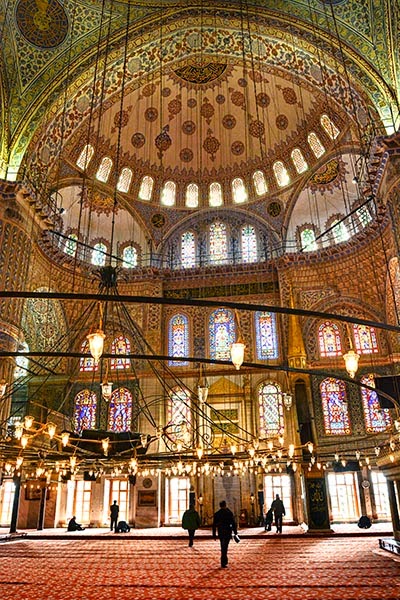
Blue Mosque Interior

Is the Dome Blue?

Is The Blue Mosque Blue?

Blue Mosque Interior | Istanbul Turkey | Terra Encounters in-depth
The mosque is one of the defining features of Istanbul’s skyline and a World Heritage Site.  Sultan Ahmet Cami (pronounced ja-mee) is better known as the Blue Mosque but is it really blue?
 
Not a Blue Breath


Entering the huge hall, your breath is taken away.  However, it is not a blue breath.  Blue is not even a dominant colour.  Except for the blue background of the calligraphy, don't expect to see blues as rich as the spectacular emeralds of the Green Tombs in Bursa.  

Luscious Light
Instead, there are many colours but they are muted.  The light pastels and white spaces enhance the perception of peacefulness. You don't even register that this is a huge dome.

Sunlight pours through the large number of windows in the dome adding to the feeling of weightlessness.  Glass was one of the inventions of the Middle East and Europe that travelled east along the Silk Routes to the Far East.
 
Venetian Glass?
The coloured glass originally was a gift to the sultan from the Signoria, the government of the Republic of Venice.  Venice went from Byzantine province to naval powerhouse, from trade funnel between Asia and Europe, to the third largest city and patron of art in Medieval Europe.  But don't expect to see exquisite Venetian glass, which has mostly been replaced by panes of lower artistic quality. 

The architect, Mehmed Ağa, like his mentor 
   
Pendentives
Sinan, married Byzantine to Islamic architecture.  The windows were clearly copied from the Byzantine Church of Hagia Sophia Dome-ination.  The dome transforms into spherical pendentives copied from Süleymaniye Mosque, Sinan's masterpiece.
    
Massive Columns


The central dome rests on four massive fluted columns often called elephant feet.  This allows for a huge central space without the use of arcades of columns as in the Ancient Roman or Medieval basilica.  Cascades of domes seem to spill down from the great central dome.


Islamic Doors

Masters of Symmetry
After removing your shoes, tourists must enter the south door.  Pause and enjoy the typical Islamic patterns carved into the rich dark wood.  The predominant Sunni sect is still adamantly opposed to images of sentient beings.
   
Images of any kind – animal, human or God – are not allowed in mosques. The reason for this is that Islam strived to end pagan worship that existed in Saudi Arabia. 
   
As a result, Islamic artists became masters of geometric patterns and calligraphy.  Symmetry and harmony is at the heart of Islamic art.  The patterns are not random.

İznik Tiles

   
Blue Tiles = Blue Mosque


Finally, we solve the question of why this is called the Blue Mosque.  The interior is lined with more than 20,000 handmade İznik ceramic tiles that are famous for the colour blue. However, they are still not a saturated blue.  The tiles have brilliant green and turquoise hues as well as blue and white. 

 
Now That's the Blues

The tiles are mostly in the inaccessible upper galleries.  Tourists are restricted to a small and separate area in the back of the ground floor.  You cannot walk around the hall nor climb to the upper galleries.  This means you need binoculars or a zoom lens to see the tiles.  The tiles display more than fifty shades of tulips, which came to Europe from Turkey. 
 
Upper Gallery Blues

The tiles at lower levels are traditional in design, while the gallery tiles are full of flowers and fruits.  For close up views of Iznik tiles, visit the Tile Kiosk in the Istanbul Archaeological Museums.
 

Islamic Prayer

Typical Floor Carpets
To the right of the mihrab is the richly decorated minbar (pulpit) where the imam stands when he is delivering the Friday sermon.  The floors are covered with carpets, which are donated by the faithful and are regularly replaced as they wear out.  Each pointed arch design in the rug marks a spot for a worshiper.
Islam requires all Muslims to pray five times a day (salat).  Find out the times in advance and be aware that they close the mosque to tourists 45 minutes before these times.  You could be waiting a long time.  In this case, look around outside as well as down the streets to see the south and west facades. 
 
Facing Mecca
However, Islam is not the only religion with this practice nor did it invent it.  Mohammed borrowed Jewish and Zoroastrian traditions.  The Judaic custom of praying three times a day (facing in the direction of Jerusalem) was originally introduced by the patriarchs Abraham, Isaac and Jacob.  These patriarchs of the Torah (Old Testament) are also patriarchs in Islam.


Private Prayers
Zoroaster lived in Ancient Persia but the dates are unknown.  It has to precede the period when Zoroastrianism became the dominant religion between 6th century BC and 6th century CE.  His real name was Zarathustra but he was called Zoroaster by the Greeks.  Elements of his philosophy travelled to the West through Judaism and Greek philosophy (Heraclitus).  There are still believers today. 
Zoroaster grew up with the Indo-Iranian pantheon, the same pantheon described under the PIE (Aryan) religion in the Dalyan and the Lycian Tombs post that was the basis for the Ancient Greek, Roman and Hindu gods.  Zoroaster dramatically simplified this pantheon into a dualistic monotheism with two forces (essentially good and evil) under one God.

Influences
Mithraism (another PIE-based religion) and its’ descendant, Zoroastrianism, were the major competitors as well as influencers of early Christianity.  See the Patara and Saturnalia post for examples of the incorporation of local customs to get people to adopt a new religion. 
    
Paisley Tie
The impact of Zoroastrianism can even be felt by modern Western civilization.  The paisley ties and textiles are not from Scotland or Kashmir; they are from the boteh motif of Ancient Persia.  It was part of the Persian inheritance from the Aryans.  In fact, Iran means land of the Aryans.
The twisted raindrop (boteh) is the quintessential metaphor of the confluence of Islamic art and Zoroastrian symbolism.  It originally represented the upright cedar tree that Zarathustra planted in paradise bent by the Muslim conquest of Persia and decorated with Islamic floral motifs.  Boteh originated in the Sassanid Dynasty (224 - 651), the last dynasty of the Persian Empire before Islamic rule.  In fact, much of what became Islamic culture was transferred from Persian art, architecture and customs. 
Sultan Ahmet Cami

Zoroastrianism, the national religion of Sassanid Persia, thus had a major influence on Islam.  One Zoroastrian tradition was to pray five times a day. Another major Zoroastrian concept is that man had free will to choose his own path between good and evil, heaven and hell.  This is the basis of all Abrahamic religions – Judaism, Christianity and Islam.  
 
Last Post:  Blue Mosque Exterior
Next Post: Kool Kadıköy