Photos

Bergama Theatre Bergama Trajan Temple Dalyan Lycian Tombs Kaprulu Kanyon Afrodisias Tetrapylon Demre Beach Ortahisar Volcanic Plug Goreme Sunset View Yoruk Turquoise Treasures and Volcanic Vistas draw Travellers to Turkey
All photos copyright © 2014 Terra Encounters All Rights Reserved
Showing posts with label Pottery & Tiles. Show all posts

Friday, 15 May 2015

Blue Mosque Interior

Is the Dome Blue?

Is The Blue Mosque Blue?

Blue Mosque Interior | Istanbul Turkey | Terra Encounters in-depth
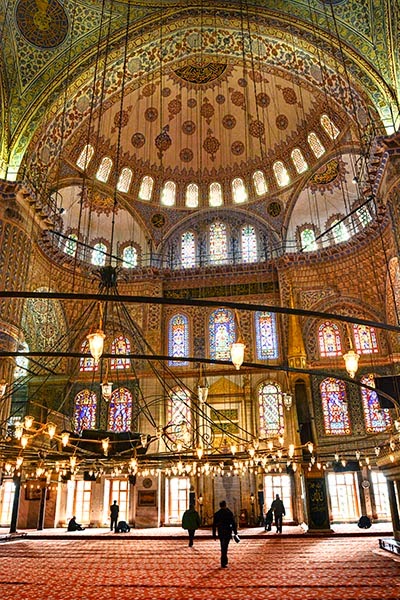
The mosque is one of the defining features of Istanbuls skyline and a World Heritage Site.  Sultan Ahmet Cami (pronounced ja-mee) is better known as the Blue Mosque but is it really blue?
 
Not a Blue Breath


Entering the huge hall, your breath is taken away.  However, it is not a blue breath.  Blue is not even a dominant colour.  Except for the blue background of the calligraphy, don't expect to see blues as rich as the spectacular emeralds of the Green Tombs in Bursa 

Luscious Light
Instead, there are many colours but they are muted.  The light pastels and white spaces enhance the perception of peacefulness. You don't even register that this is a huge dome.

Sunlight pours through the large number of windows in the dome adding to the feeling of weightlessness.  Glass was one of the inventions of the Middle East and Europe that travelled east along the Silk Routes to the Far East.
 
Venetian Glass?
The coloured glass originally was a gift to the sultan from the Signoria, the government of the Republic of Venice.  Venice went from Byzantine province to naval powerhouse, from trade funnel between Asia and Europe, to the third largest city and patron of art in Medieval Europe.  But don't expect to see exquisite Venetian glass, which has mostly been replaced by panes of lower artistic quality. 

The architect, Mehmed Ağa, like his mentor 
   
Pendentives
Sinan, married Byzantine to Islamic architecture.  The windows were clearly copied from the Byzantine Church of Hagia Sophia Dome-ination.  The dome transforms into spherical pendentives copied from Süleymaniye Mosque, Sinan's masterpiece.
    
Massive Columns


The central dome rests on four massive fluted columns often called elephant feet.  This allows for a huge central space without the use of arcades of columns as in the Ancient Roman or Medieval basilica.  Cascades of domes seem to spill down from the great central dome.


Islamic Doors

Masters of Symmetry
After removing your shoes, tourists must enter the south door.  Pause and enjoy the typical Islamic patterns carved into the rich dark wood.  The predominant Sunni sect is still adamantly opposed to images of sentient beings.
   
Images of any kind – animal, human or God – are not allowed in mosques. The reason for this is that Islam strived to end pagan worship that existed in Saudi Arabia. 
   
As a result, Islamic artists became masters of geometric patterns and calligraphy.  Symmetry and harmony is at the heart of Islamic art.  The patterns are not random.

İznik Tiles

   
Blue Tiles = Blue Mosque


Finally, we solve the question of why this is called the Blue Mosque.  The interior is lined with more than 20,000 handmade İznik ceramic tiles that are famous for the colour blue. However, they are still not a saturated blue.  The tiles have brilliant green and turquoise hues as well as blue and white. 

 
Now That's the Blues

The tiles are mostly in the inaccessible upper galleries.  Tourists are restricted to a small and separate area in the back of the ground floor.  You cannot walk around the hall nor climb to the upper galleries.  This means you need binoculars or a zoom lens to see the tiles.  The tiles display more than fifty shades of tulips, which came to Europe from Turkey. 
 
Upper Gallery Blues

The tiles at lower levels are traditional in design, while the gallery tiles are full of flowers and fruits.  For close up views of Iznik tiles, visit the Tile Kiosk in the Istanbul Archaeological Museums.
 

Islamic Prayer

Typical Floor Carpets
To the right of the mihrab is the richly decorated minbar (pulpit) where the imam stands when he is delivering the Friday sermon.  The floors are covered with carpets, which are donated by the faithful and are regularly replaced as they wear out.  Each pointed arch design in the rug marks a spot for a worshiper.
Islam requires all Muslims to pray five times a day (salat).  Find out the times in advance and be aware that they close the mosque to tourists 45 minutes before these times.  You could be waiting a long time.  In this case, look around outside as well as down the streets to see the south and west facades. 
 
Facing Mecca
However, Islam is not the only religion with this practice nor did it invent it.  Mohammed borrowed Jewish and Zoroastrian traditions.  The Judaic custom of praying three times a day (facing in the direction of Jerusalem) was originally introduced by the patriarchs Abraham, Isaac and Jacob.  These patriarchs of the Torah (Old Testament) are also patriarchs in Islam.

Private Prayers
Zoroaster lived in Ancient Persia but the dates are unknown.  It has to precede the period when Zoroastrianism became the dominant religion between 6th century BC and 6th century CE.  His real name was Zarathustra but he was called Zoroaster by the Greeks.  Elements of his philosophy travelled to the West through Judaism and Greek philosophy (Heraclitus).  There are still believers today. 
Zoroaster grew up with the Indo-Iranian pantheon, the same pantheon described under the PIE (Aryan) religion in the Dalyan and the Lycian Tombs post that was the basis for the Ancient Greek, Roman and Hindu gods.  Zoroaster dramatically simplified this pantheon into a dualistic monotheism with two forces (essentially good and evil) under one God.

Influences
Mithraism (another PIE-based religion) and its’ descendant, Zoroastrianism, were the major competitors as well as influencers of early Christianity.  See the Patara and Saturnalia post for examples of the incorporation of local customs to get people to adopt a new religion. 
    
Paisley Tie
The impact of Zoroastrianism can even be felt by modern Western civilization.  The paisley ties and textiles are not from Scotland or Kashmir; they are from the boteh motif of Ancient Persia.  It was part of the Persian inheritance from the Aryans.  In fact, Iran means land of the Aryans.
The twisted raindrop (boteh) is the quintessential metaphor of the confluence of Islamic art and Zoroastrian symbolism.  It originally represented the upright cedar tree that Zarathustra planted in paradise bent by the Muslim conquest of Persia and decorated with Islamic floral motifs.  Boteh originated in the Sassanid Dynasty (224 - 651), the last dynasty of the Persian Empire before Islamic rule.  In fact, much of what became Islamic culture was transferred from Persian art, architecture and customs. 
Sultan Ahmet Cami

Zoroastrianism, the national religion of Sassanid Persia, thus had a major influence on Islam.  One Zoroastrian tradition was to pray five times a day. Another major Zoroastrian concept is that man had free will to choose his own path between good and evil, heaven and hell.  This is the basis of all Abrahamic religions – Judaism, Christianity and Islam.  
 
Last Post:  Blue Mosque Exterior
Next Post: Kool Kadıköy


Tuesday, 13 May 2014

Green Mosque, Bursa

Yeşil Cami

gorgeous green tiles of Yeşil Türbe
Gorgeous Green
Green Mosque, Yeşil Cami, Yeşil Türbe, Bursa, Turkey, Ottoman houseToday was our big travel day but will we make it to Yeşil Cami in Bursa?  Will we learn why the Green Mosque is in Bursa?  First we had to have our Trial by Tire.  We had to experience İstanbul traffic from behind the wheel.  Did I mention that in Turkey “lanes are just a suggestion”?  This was followed by Trial by Signage – or lack thereof.

Note that when you click on a photo (only in a post) it starts a slide show of those photos.  The main advantage is that the photos are shown much larger.  
 

Getting out of Taksim

 
After another sumptuous breakfast, Sirkeci Mansion called a taxi for us to go to Hertz at Taksim Square, which cost TRY 20.  We left at 09:00 h and at least six staff came out the door waving us goodbye!!!  It was a royal send-off.  I wish I had taken a picture but the taxi was waiting.

The Hertz people were not that friendly; very business-like.  When I asked directions for Bursa they said just go straight up their street then follow the blue signs.  But there were no signs, blue or green. Their road led us back west across the bridge to Sultanahmet.  Then we went the wrong way heading north up the Golden Horn.  Now it was trial by fire – I mean tire – experiencing first hand driving in Istanbul.  Oh, did I mention the lack of street and direction signs in Istanbul?

I finally turned around and went further south to the Galata Bridge and make a U-turn.  Since we had travelled to Taksim by tram, I saw a sign for the name that is the last stop of the tram, Kabataş.  It took another half an hour to go 10 km from Galata Bridge.  So at 11:00 h we were finally on our way.

Thanks to Google Maps and tablets, I knew the road to the highway veered left one km after Dolmabahçe Palace. There was still no sign at that intersection saying this way to autostrada (oops, wrong country)!  Doesn’t İstanbul have lots of tourists, even Turkish ones?

It was bumper to bumper until we crossed the amazingly high bridge to Asia and passed through the toll gates.  Tolls are very low in Turkey.  The driving was fine but Turkish drivers cut in or pass with very little room and Istanbul stretches on and on.  Once we passed the Sabiha Gökçen (Asian-side) airport the traffic thinned and it was very easy driving on a modern, six-lane divided expressway.
 

The Road to Bursa

 
Even though we did not have connectivity, I had the Google Map of Istanbul to Bursa open and we could follow the big blue dot (our GPS position).  As we reached the end of the Sea of Marmaris, we turned west on D130 to Bursa.  We thought it was the end of expressway driving but the D130 was a six-lane divided highway almost all the way except when driving through some towns.

However, it was the worst day with lots of rain especially as we crossed over a low mountain pass.  It was easy to find our hotel as it was right off this highway as we got into Bursa.  We arrived at 15:45h at the Hampton Hilton, which is very modern.  The young woman at check-in was very helpful and gave us suggestions that were definitely worthwhile.  Our room was very plush and had a coach and chair.  The breakfast was extensive and we sat in a sun-filled part of the dining area.  It was the most expensive place of our trip at TRY 222 per night.  In our research, Bursa hotels are more expensive and the cheaper Osmangazi hotels had significant “terrible” ratings with lots of bad reviews.

The Road to Heaven


carving in stone on Yeşil Cami's  exterior
Yeşil Cami
To make the most of the day, we wanted to see Yeşil Mosque and tombs.  As I was driving (back and forth), I missed the turn three times but was able to go down another street by watching where the blue dot was on our tablet.  Once again there are no signs for what is one of the main tourist sights of the city, but we were able to find it.

Yeşil Cami (Green Mosque) is as much blue as it is green.  There are a few walls covered in blue-green tiles but the semi-circular tympana over the doors are blue tiles.  There is one side room that is beautifully tiled with patterns in a myriad of colours.  The mosque is very understated and, best of all, there are hardly any people.  Also notice the decorative carved marble on the exterior.  The mosque is on a hill with some nice views as well as some nice pastel-coloured homes.  Up some stairs across from the Green Mosque is the Green Tombs. 


gorgeous turquoise tiles of Yeşil Türbe
Green Tombs
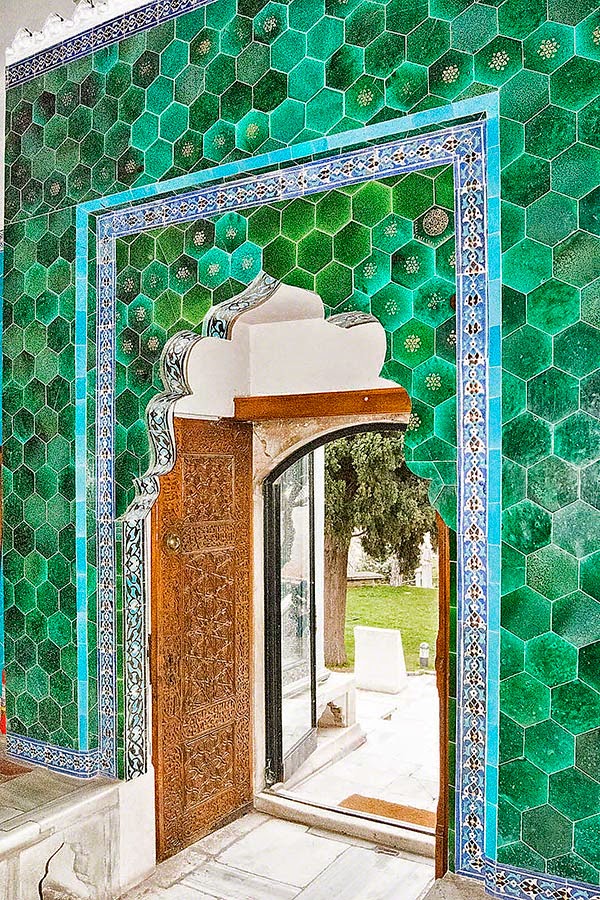
It is really Yeşil Türbe (tombs) that blew us away and is the must-see.  The exterior of the mausoleum is clad with green-blue tiles that give it its name.  Again the tiles inside are really turquoise except for the gorgeous emerald green tiles around the doorway. 

tiled mihrab in Yeşil Türbe
Green-Gold Mihrab
Green is the colour associated to Islam. Heaven is described as containing green carpets and green silk garments.  Perhaps this is related to Islam's origin in a desert country with little green.  The lower half of the walls is lined with exquisite turquoise tiles.  The inlaid front doors are carved in a rich, dark wood.


Finally we went to eat supper at Iskender Kebab.  Living here in Bursa, Iskender invented the gyro machine and the döner made with it.  We ate a lot but we had missed lunch.  Again I was able to find the restaurant street as well as the way back to the Hamptons.


Last  Post: Süleymaniye Mosque Dome-ination
Next Post: Cumalikizik & Bursa - Ottoman Delight

Friday, 9 May 2014

Istanbul Archaeology Museums

Istanbul Archaeology Museums


Be sure to see at least the classical sculpture, the incredible tiles and pottery from the city of Iznik, and the Ishtar GateBelow are just a few examples that will expand your knowledge about ancient times, show just how interrelated our cultures are, and hopefully amaze you about things we take for granted today. 

Day 3 PM: In particular be sure to see at least the ground floor of the Archaeological Museum (main building).  Second see the incredible tiles from the city of Iznik in the Museum of Islamic Art (also known as Tiled Kiosk).  By the way, the English work kiosk comes from Turkish word köşk (pavilion). Finally go to the Museum of the Ancient Orient to at least see the treasure from ancient Babylon.  Note that these are three separate museums but right next to each other.  The museum is open 9:00 to 17:00 h but closed Mondays.  There are so many interesting artifacts to see that an afternoon was barely enough time.  As with any museum, trying to see everything without learning more about specific artefacts can be overwhelming and you will get "museumed out". 

Archaeological Museum


Alexander Sarcophagus


Alexander the Great is the figure on the left on a horse
The Alexander Sarcophagus, found in Sidon (Lebanon), is one of the most important artifacts in the museum. No Alexander the Great was not buried in here! It is so named because it portrays him fighting at the Battle of Issus where Alexander defeated the Persians in 333 BC.
 
Alexander is shown on his horse, preparing to thrust a spear at the Persian cavalry. Greek and Persian soldiers can easily be distinguished. Persians, Turks and other Central Asians who lived a horse-riding culture wore trousers. Greeks, due to their hotter climate, wore short tunics. 

Please note the remnants of red paint on the left side.  One of the most surprising things about the Classical Period is that the marble, which we consider beautiful on its own, was covered in bright paint colours.  Look at the painted model along the wall.  This applies to all the famous classical sculptures seen in museums everywhere and not just those here in Turkey. So keep that in mind next time your are in Athens or Rome.

Alexander Sarcophagus geometric borders
Greek Geometric Borders
Alexander wanted to not only establish a Greek-Persian empire but also develop a combined Eastern and Hellenistic culture. He even married a Persian princess, wore Persian clothes and accepted Persian dynastic customs. 

Today we all wear pants because the nomadic horse-riding tribes from Central Asia –  which includes the Turks ‒ brought that custom west with them
 
Similarly, the sarcophagus is a combination of Greek-style bas-relief and motifs (such as the never-ending lines and egg-and-dart motif at the bottom of the photo) and Eastern art (such as the swastika, which was an ancient symbol throughout the East for auspiciousness). 

Alexander's Bust


Alexander the Great Bust
Alexander the Great was one of the first rulers to understand and exploit coins, portraits and sculpture for their propaganda value.  Coins were first introduced around the 7th century BC by the Lydians (western Turkey)!  After Alexander all rulers minted coins with their face profile on the “heads” side and some propaganda symbol of the state on the tails side.  Similarly his statues were made to look god-like.  Alexander adopted the Asian idea of honouring rulers as if they were gods.  So statues showed characteristics that had been used to represent gods and heroes: hair like a lion's mane, the face of an idealized youth...

Alexander sought to hybridize Greek and Persian culture and homogenize the populations of Asia and Europe.  Of particular historical importance is that Anatolia (Turkey) became a Greek colony.  The bust of Alexander the Great (2nd century BC) was found in Pergamum (Bergama), Turkey.  Alexander brought Greek artisans and culture with him.  So we can be reasonably sure that this bust was carved by his sole sculptor, Lysippus, who was considered one of the three greatest sculptors of the Classical Greek era.

The sculptors imported to Gandhara (Gandahar, Afghanistan) had an even more significant impact on Asia. Greek sculptors created the first sculptures (with togas and Greek faces) of Buddha, who had explicitly forbade images.   Now there are sculptures of Buddha all over the world.
 

Silk Routes


The Hellenistic Empire led to increased contact between East and West and thus increased desire for trade. This led to the Silk Routes (it was not one road; it was sometimes by ocean) and the impact of ideas and inventions, arts and science on both east and west that we now take for granted

 think paper, toilet paper, paper currency, printing, porcelain, silk, foods, spices, compass, gunpowder, and the Black Death plague to name just a few.
 

Sarcophagus of the Crying Women


Sarcophagus of the Crying Women
The Sarcophagus of the Crying Women, found in Sidon (Lebanon), is an example of Hellenization of west Asia.  The Sarcophagus represents an Ionian temple; note the columns. The crying women were a common funerary motif in the Middle Eastern countries.

This is the tomb of Abdalonymus who was born in the royal family but fell on hard times and was working as a gardener in 332 BC.  He was made king of Sidon by Alexander the Great, as the previous king died in battle with Alexander.

Tiled Kiosk Çinili Köşk


The Tiled Kiosk (1472) is one of the oldest structures in Istanbul but it is not Ottoman architecture. The polygonal pillars of the façade are typical of Persian architecture. It was a part of the Topkapı Palace outer gardens.
  

Iznik Mosque LampIznik Mosque Lamp

 
The workshops of İznik developed a type of white ware that they painted with cobalt blue and sealed with a colourless lead glaze.  Turquoise and coral colours were added to later pottery.  They combined traditional Ottoman arabesque patterns with Chinese motifs.  
 
There was a tradition of hanging pottery lamps in mosques. The opaque pottery lamps were more for decoration than for lighting. The lamps are decorated with geometric motifs, large rosettes and stylized lotus blossoms. 

There are 10,000 pieces Chinese porcelain in the Topkapi Palace but almost no İznik pottery!
 
Tile Mihrab

Tile Mihrab


Why is the Blue Mosque blue?  It is decorated with thousands of blue tiles from Iznik.  But why did they make blue and white tiles?  

The Ottoman court liked the blue and white porcelain from China.  Blame it on the Silk Routes!  From the 9th century onwards, Islamic merchants started to import Chinese ceramics, which were the prime export of the Indian Ocean Silk sea route.  Of course, no one else knew how to make porcelain at that time.

This tile mihrab was made using this colourful glazing technique.  The tiles are ornamented with herbal and geometric figures.
 

Fountain of Youth peacockFountain of Youth

 
Fountain of Youth

Imagine a room covered with rich gold, dark blue and turquoise tiles as seen in the photo on the left.  It takes your breathe away. 
 
Then at the end of the room is a fountain built in the year 1590.  There is a figure of a peacock in the middle of herbal motifs.  The ornaments are hand-carved and gilded. Now that is ornate!   

Museum of the Ancient Orient


Ishtar Gate


Ishtar Processional Way Lions
The Ishtar gate was part of one of the seven wonders of the ancient world, Babylon!   

Babylon was dedicated to Ishtar, the Babylonian goddess of goddess of fertility, love and war -- all the important things. Ishtar Gate was constructed in 575 BC under Nebuchadnezzar II using glazed brick with alternating rows of bas-relief.

Leading to the gate was a glazed tile wall, the Processional Way for major celebrations like the New Years Festival. This fragment is decorated with Lions and flowers. Why lions?   The lion was the animal associated with goddess Ishtar and symbolized her protection of the street.  Its repeated design served as a guide for the ritual processions from the city to the temple.

The glazes were made by pigments were blended with melted silica.  Blue was a rare natural colour in the Mesopotamia.  Some web sites say that the bricks are glazed with lapus lazili. This is an expensive turquoise stone even back then, so this is extremely unlikely. 

What is amazing is how saturated the colour of the glazed bricks are considering they are 2500 years old.  You look in disbelief thinking are these real?   
 
Last  Post: Hagia Sophia Dome-ination (Day 3 AM)

Next Post: Gulhane Park (Day 3 PM)

Sunday, 27 April 2014

Topkapi Palace Paradise

Topkapi Palace: Harem Gorgeous Tiles

Topkapi Palace Paradise

Our first day focuses on the seat of Ottoman power and paradise, the Topkapi Palace - if we can ever leave the delights of our present-day palace!  The Topkapi Palace is the first place you should visit in Istanbul.  The highlights are the Harem, Divan, Bagdad Pavilion and the Treasury filled with jewels and spectacular arts. 

Note: hover mouse over photo for caption.  Click any photo to start slideshow with larger images.


Sirkeci Mansion Modern Delights


Sirkeci Mansion: Breakfast Buffet
Day 2: We had a slow start this AM and took our time munching through a very big breakfast with a large selection of food, both hot and cold dishes. They had a hot cheese and veggie dish that was salty. The breads were very fresh and must come from a bakery. The small roll with sesame seeds on top is the best bread so far. The coffee was very strong but smooth.
It was cloudy and cool so we'll do the outdoor sightseeing and Bosphorus boat trips on our second visit to Istanbul at the end of this trip.  The hotel sold us a TRY 85 museum card, which is good for only three consecutive days.  It was a short 10 minute walk to Sirkeci Station to get the transit card.  Our hotel was right off the tramway, which is a great service.  Each trip is very low cost (and lower with the transit card) but there are no transfers.
 
Topkapi Palace: Official Sahlep Seller to the Sultan
Official Sahlep Seller to the Sultan
We left at c 1100h and took the busy tram to the Sultanahmet stop then walked to Topkapi Palace.  Be sure to try the sahlep drink outside the Topkapi entrance.  This aromatic drink – made from wild orchid root, milk, honey, cinnamon and vanilla – is only available in the winter (October to April).  It costs TRY 5 at Topkapi but elsewhere in Turkey we had it for TRY 2 or 3.  Delicious!

Turkish Origins


The Turks are not from Turkey!  They are from Central Asia.  They are believed to have originated from the Xiongnu, the "Northern Barbarians" – the bane of the Han Dynasty and cause for the Great Wall!  The Turks migrated gradually westwards and invaded Anatolia and defeated the Byzantines near Lake Van (East TR) in 1071.  After the Turks conquered Constantinople in 1453, their dynasty became known as the Ottomans (Osman in Turkish) and ruled for 624 years.  At its peak the Ottoman Empire stretched from Algeria to Mecca, from Hungary to Iraq including Romania and Crimea.  The Ottoman Empire disintegrated as a result of supporting Germany in World War I.  This led to the emergence of the new state of Turkey as well as independence for the various other states. 
 

Topkapi Palace


Topkapi Palace: Gorgeous Iznik Tiles
The Topkapi Palace was begun in 1453, just after the Ottoman Empire conquered Constantinople, and renamed it Istanbul (see "Polis" section)Wow, what a place! Unless you are museum-adverse person, you could spend a full day here. Six hours was barely enough time. The palace is arranged around four treed and grassy courtyards.
 

Topkapi Palace Harem

 
The harem is an extra TRY 15 (but included in the Museum Pass) and it was the most interesting part of Topkapi Palace. Go there first, well after visiting the Divan or council building. The magnificent tiled walls are lined with cushioned seats, which led to the use of the word divan (couch) in our language. The tiles are always geometric shapes with lots of turquoise and blue colours. Islamic artisans used mathematical precision to produce symmetry and repetition. The depiction of the human form is considered idolatry. The doors are inlaid mother of pearl and wood.


Topkapi Palace: The Sultan's Bedroom
The harem is the living quarters of the palace.  It is also a maze of beautiful tiles and inlaid wood.  It was the sultan's mother who ran the palace and sometimes even the country. She controlled the Sultan's his wives (maximum four) and decided who should be his four favourites, even who and when he had sex. The rest of the women in the harem were only servants and did not have sex with the sultan. The main purpose was to ensure there was a male heir. 

We did not go to a restaurant to eat lunch because we knew we had limited time.  So we took a rest on a bench in the outdoor Courtyard of Favourites with its view of Galata Tower in Beyoğlu. Fortunately, we had some snacks like halvah: it was delicious but very similar to what we can get back home.
 

Topkapi Palace Tulips & Jewels


Topkapi Palace: Harem
After the harem we toured the Fourth Courtyard with its gardens full of tulips.  The Turks introduced the Central Asian tulip to Europe, and today Netherlands is the biggest cultivator.  The Bagdad Pavilion has an interesting fountain pool.  We left the jewel and other treasury rooms to the end because there were too many people lined up.  The lines were shorter at the end of the day. This is another must-see definitely spectacular arts, crafts, weapons and jewels.

We stayed at Topkapi Palace all day and were the last ones out at 17:00h!!!  Then we met some PhD students (Turkish lady and Iranian man) in the courtyard and had a long conversation.  The guards had to come and kick us out.  Then we made the long walk back to the Sultan Ahmet Parki with its colorful cascading fountain in between Hagia Sophia (Aya Sofya) and the Blue Mosque.   
 

Antiochland Restaurant


Antiochland Restaurant: What a Meze

From there were walked up Yerebatan Street to the Antiochland Restaurant. We had another good meal. The Anatolia is up Ticarethane Sk. about one long block from Divan Yolu, the main street with the tramway.  In fact I recognized the Divan Yolu intersection from one of my sister's photos from her trip five months earlier.  The restaurant provided a better type of pitta bread.  The meze (small appetizers) was particularly delicious.  We had a long discussion with the waiter about the herbs and spices used.  We also met and talked with the chef/owner.

We also talked with our neighbours at the next table who sounded British but were from Sweden.  One is a teacher and the other arranges music group cultural exchanges.  They flew down for 5 days – it is only a three-hour flight!!  They said they will connect with us on Facebook. 

We walked down a steep road to our hotel because the walk back to Sultanahmet stop was longer and we would still need to take the tram which would take even longer.  Moreover, sometimes it is so busy that you do not even get a seat on the tram. 

Last  Post: Merhaba to Turkey (Day 1)
Next Post: Hagia Sophia Dome-ination (Day 3 AM)